
Time Thieves: The Hidden Drains On Your Teen’s Day
Losing track of time, or focus, is a common issue faced by teens when it comes to revision. In this article we look at six

The decorations are down, the routine is back, and the school gates open. Hurrah!
It’s easy to treat the first week back as a “buffer week” – a time to slowly wade back into the water. Ease yourself back in. But if you want to avoid the mid-term panic and the late-night cramming sessions that inevitably follow a slow start, you need to flip the switch now.
This isn’t about making “resolutions” that break by February. This is about a fundamental mindset shift. It’s about moving your teen away from being a passive passenger to being the driving force behind their acheivements.

Often, back-to-school anxiety comes from a feeling of losing control. When students use ineffective study techniques, they’re essentially driving with the handbrake on—working twice as hard for half the distance.
In this article, we talk about how to help your teen take the driver’s seat this term. No more “idling” in procrastination or “spinning wheels” in panic. Just a clear, “can-do” approach to the new school year.
If they’re currently ignoring the revision list or pretending that exams are a lifetime away, listen up: The calendar doesn’t care about your denial. Anxiety usually lives in the gap between what should be done and what is actually being done. The longer the books are closed, the bigger that gap gets, and the louder the “background hum” of stress becomes.
The Fix: Stop waiting to “feel like it”. Motivation follows action, not the other way around. Open the planner, look at the reality of the term ahead, and own it. Once they have a plan, the “monster under the bed” suddenly looks a lot smaller.
[Check out our Course Checklists for a quick start assessment of the current situation.]
We all know the trap: “I’ll start properly on Monday.” Then Monday becomes Wednesday, and Wednesday becomes “next week.”
Procrastination isn’t just laziness; it’s a choice to trade your future peace of mind for ten minutes of scrolling or gaming. Every time you delay a task, you are effectively stealing time from “Future-You.”
The Fix: Adopt a “can-do” immediacy. If a task takes less than ten minutes, do it now. If it’s a big project, break it into a thirty-minute sprint. Don’t aim for perfection; aim for completion. Get it off your plate so you can enjoy your downtime without the guilt.
It is a tough pill to swallow, but worrying is not work. We see many students who are genuinely anxious about their results, to the point of making themselves ill, yet they aren’t seeing the grades they want.
Often, the root of this anxiety isn’t a lack of effort – it’s ineffective technique. If a student spends four hours “highlighting a textbook” or “re-reading notes,” they are performing “passive learning.” It feels like work, but it doesn’t stick. When they realise they don’t actually know the material, the panic sets in. They think they aren’t “smart enough,” when the reality is they just haven’t been “smart enough” with their time.
The Fix: If your teen is spiraling, don’t just tell them to “relax.” Instead, help them focus on active, evidence-based study. * Stop the “Busy-Work”: Ditch the pretty revision posters and the endless re-reading.
Embrace the Struggle: Focus on flashcards, past paper questions, and active recall. This is harder work, but it’s more effective and takes less time.
Control the Controllables: You can’t control the exam questions, but you can control the study plan. A clear, logical schedule (like the one we use at The Study Buddy) is the best known cure for academic anxiety. It turns a giant, terrifying mountain into a series of manageable steps.
A “can-do” attitude isn’t about being cheery or pretending everything is easy. It’s about resilience. It’s the belief that while you can’t control the difficulty of the exam paper, you have 100% control over your preparation.
Ditch the “I’m bad at this” talk. Replace it with “I haven’t mastered this yet.”
Stop viewing study as a chore. View it as a training session. You’re building the “muscle” of focus.
Take the wins. Finished a tough chapter? That’s a win. Stuck to your schedule for two days more than last week? That’s a win. Build momentum.
Success in the coming months isn’t going to be down to luck, and it isn’t going to be down to “natural talent”. It’s going to be down to the intentions you set tomorrow morning that you follow through on.
Are you going to drift through the term and hope for the best? Or are you going to take the wheel?
Let’s get to work.
Take the guesswork out of revision and help your teen find their flow. Click below to find the perfect Study Buddy setup for the upcoming mock exam season.
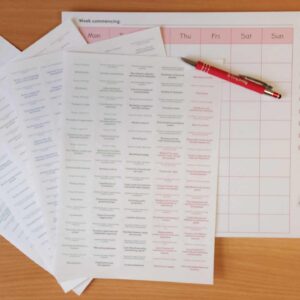
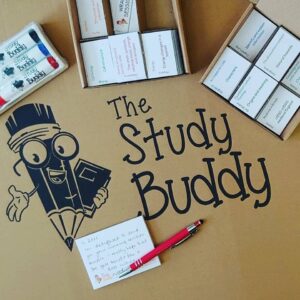
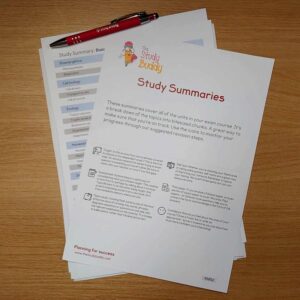
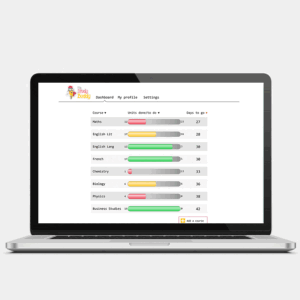
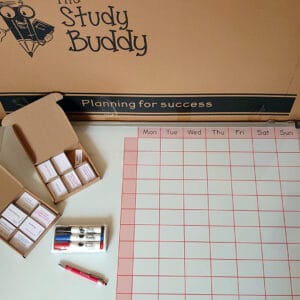

Our GCSE Special bundle is everything you need to get going quickly and easily.
Losing track of time, or focus, is a common issue faced by teens when it comes to revision. In this article we look at six

If you’re using past papers to try and guess what’s coming up in June, you’re practicing “Black Arts,” not revision. Trying to spot patterns in

Happy Pi Day! Beyond the geometry and the actual pie, March 14th is a masterclass in human memory. We’re exploring the science of encoding—the clever
An offer code will be sent to you. By subscribing to our newsletter you agree to our Terms and Conditions and Privacy Policy. You can unsubscribe at any time.
Thank you for signing up! Check your inbox soon for special offers from us.
In the meantime, you can use the code Welcome5