Time Thieves: The Hidden Drains On Your Teen’s Day
Losing track of time, or focus, is a common issue faced by teens when it comes to revision. In this article we look at six

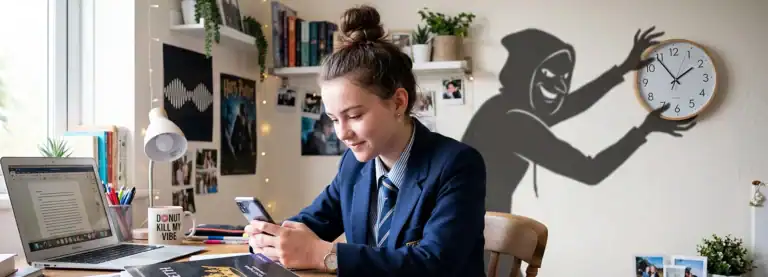
We’ve all seen it. Your teen sits down to revise. They have their textbook open, three highlighters ready, a laptop for “research,” and a massive to-do list scribbled on a piece of paper. Ten minutes later, they’re staring at the wall or scrolling through their phone.
To a parent, it looks like a lack of motivation. To a scientist, it looks like Cognitive Overload.
Developed by educational psychologist John Sweller in the 1980s, Cognitive Load Theory (CLT) is based on a simple truth about the human brain: Our working memory is a small cup, but the information we try to pour into it is often a gallon jug.
Working memory (what we used to call short-term memory) is the part of our brain where we consciously process information. It’s small, temporary, and easily overwhelmed. Research suggests we can only hold about 4 to 7 “chunks” of new information at once. If we try to add an 8th, something else spills out.
There are three types of “load” that fill up your teen’s brain:
Intrinsic Load: How hard the actual topic is (e.g., Quantum Physics vs. basic addition).
Extraneous Load: The “clutter” – confused instructions, a loud room, or the stress of not knowing what to do next.
Germane Load: The “good” work – the actual brain power used to turn new info into long-term memories.
The Goal: We want to minimise the clutter (Extraneous) so there is more room for the learning (Germane).
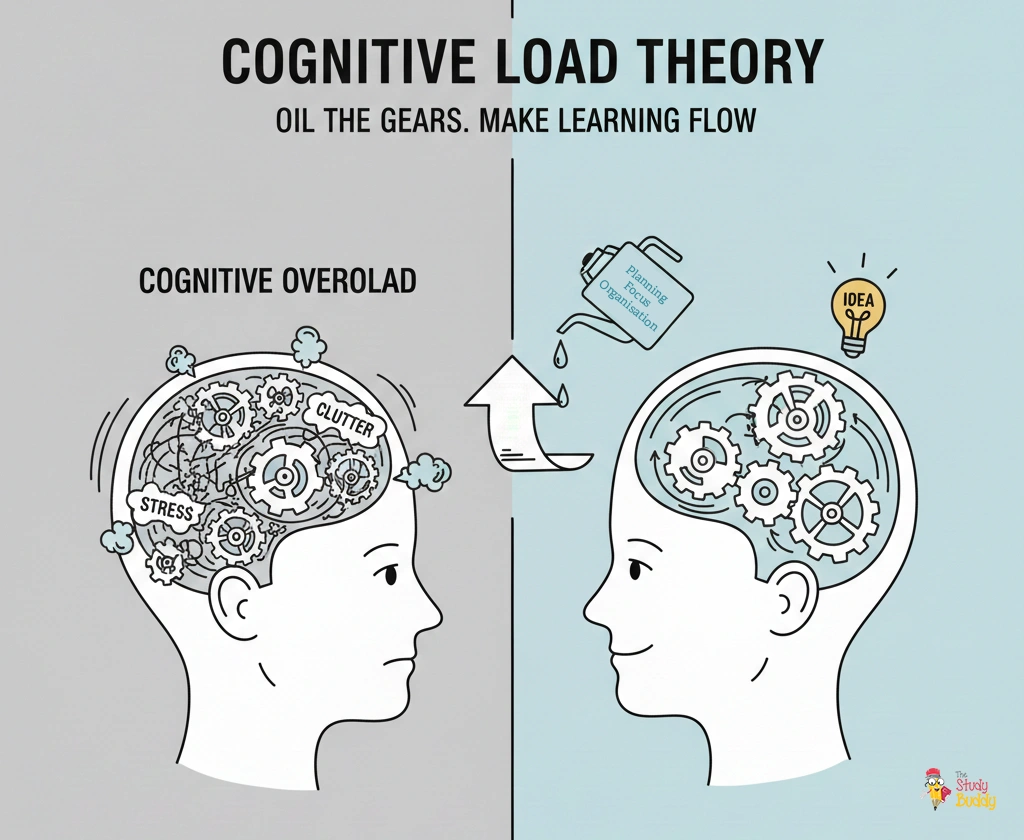
When a student has a massive, unorganised list of things to do, their working memory is constantly “leaking” energy just trying to keep track of the scale of the task.
“I need to do Biology… but wait, when is the Geography test? Did I finish that essay? How much time do I have left? Why can’t I remember Inspector Calls’ quotes…”
This internal dialogue is the Extraneous Load. It fills up the “cup” before they’ve even read a single page of their textbook.
You can’t make the subject (Intrinsic Load) easier, but you can clear the clutter. Here is how to apply CLT at home:
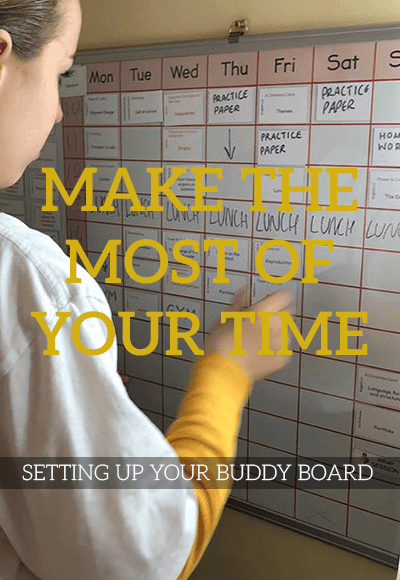
Don’t let the plan live in their head. Use a visual system – like The Study Buddy – to move the “What do I do?” out of the brain and onto the wall. Once a student can see their plan, their brain stops spending energy trying to remember it.
If a task feels too big, it’s because the “Intrinsic Load” is too high. Break a 2-hour revision session into topics. A magnet that says “The Carbon Cycle” is much easier for the brain to process than one that says “Biology Paper 1.”
Research shows that having to look at two different sources at once (like a video and a textbook that don’t match) creates a “Split Attention Effect” that kills learning. Encourage them to focus on one resource at a time (and definitely not have Netflix running at the same time!).
A messy desk is a messy mind. Clear the space so that the only thing in their field of vision is the material they are studying – and their Study Buddy board, which shows them exactly where they are in their day.
When your teen says they “can’t do it,” they might just be out of cognitive space. By using a structured, visual system, you aren’t just helping them organise – you are literally freeing up their brain to learn.
Tackle the grinding gears effective of not knowing what to do out of the situation. Our tools are all about helping your teen get up and running with minimal effort. Click below to find the perfect Study Buddy setup for the upcoming mocks and exam season.
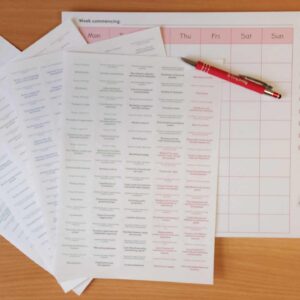
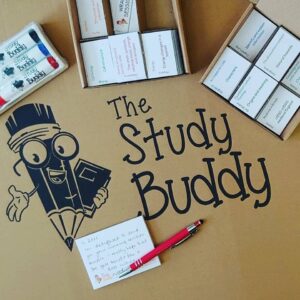
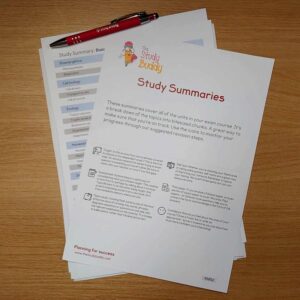
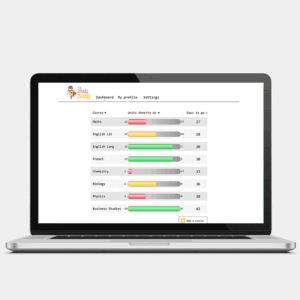
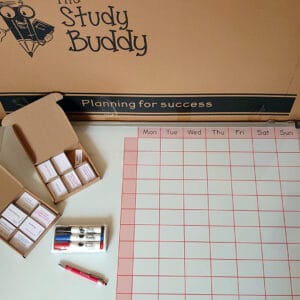
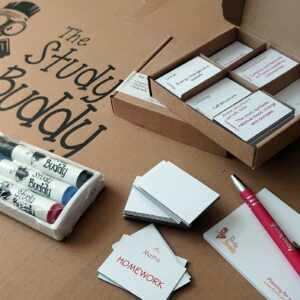
Our GCSE Special bundle is everything you need to get going quickly and easily.
Losing track of time, or focus, is a common issue faced by teens when it comes to revision. In this article we look at six

If you’re using past papers to try and guess what’s coming up in June, you’re practicing “Black Arts,” not revision. Trying to spot patterns in

Happy Pi Day! Beyond the geometry and the actual pie, March 14th is a masterclass in human memory. We’re exploring the science of encoding—the clever
An offer code will be sent to you. By subscribing to our newsletter you agree to our Terms and Conditions and Privacy Policy. You can unsubscribe at any time.
Thank you for signing up! Check your inbox soon for special offers from us.
In the meantime, you can use the code Welcome5